Quick answer
Choose among cyber security companies in Dubai on evidence, not logos. Check which services each firm delivers with its own staff, the certifications of the people doing the work, how 24/7 monitoring and incident response actually run, which UAE regulations it can map controls to, and how it will protect your data and admin access. Ask for sample reports and a named escalation path before you sign.
Types of cyber security companies in Dubai, and which you need
Searches for cyber security companies in Dubai return very different businesses side by side: global vendors, regional distributors, integrators, managed security providers and consultancies. They are not interchangeable, and many shortlists go wrong because they compare a product reseller with a consultancy on the same criteria.
| Type | What it does | Choose it when |
|---|---|---|
| Vendor | Builds the product: firewall, EDR, email security, SIEM | You have chosen the technology and need vendor support or licensing direct |
| Distributor | Supplies vendor products to resellers and integrators, usually not to end customers | Rarely relevant to an end customer, except to confirm a partner is authorised |
| Integrator or reseller | Designs, supplies, installs and configures security products | You need a project delivered: a firewall refresh, an EDR roll-out, MFA |
| Managed security provider (MSSP or MDR) | Monitors, investigates and responds to alerts as an ongoing service | You lack a team that can watch alerts outside office hours |
| Consultancy or assessor | Penetration testing, risk assessment, compliance and audit readiness | You need an independent view, a regulatory gap analysis or test evidence |
| Incident response firm | Contains and investigates breaches, often on retainer | You want guaranteed help during a live incident |
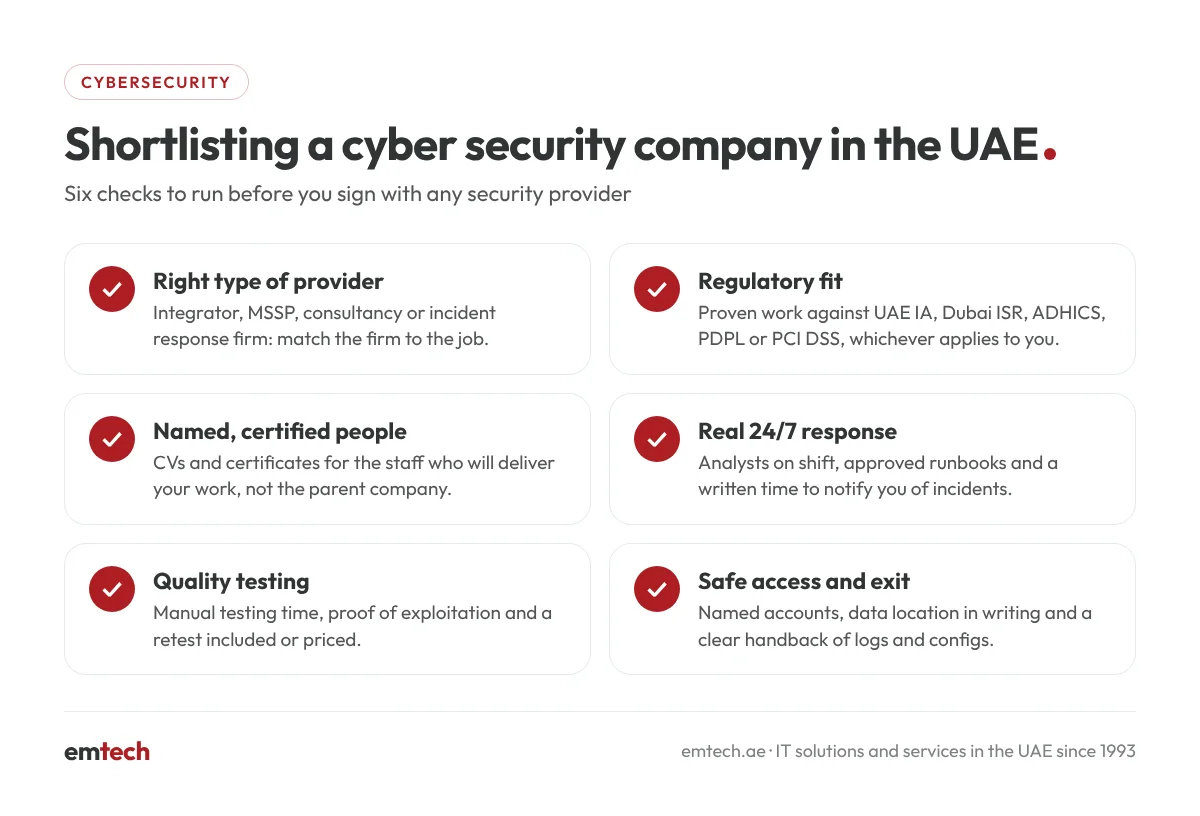
Many UAE firms span two or three of these roles. That can be efficient, but ask which roles the company performs with its own staff and which it subcontracts. A useful conflict-of-interest check: the firm that installed your firewall is not the ideal choice to penetration test it.
Match cyber security services in the UAE to your regulatory obligations
Your regulator often narrows the field before price does. Ask each provider which of these frameworks it has delivered work against, and request an anonymised example of the output.
| Framework | Who it applies to | What to ask the provider |
|---|---|---|
| UAE Information Assurance (IA) Regulation | Government entities and critical information infrastructure, under the UAE Cyber Security Council | Can you run a control gap assessment and produce evidence for each control family? |
| Dubai Information Security Regulation (ISR), DESC | Dubai Government entities | Have you mapped controls to the ISR, and are your testers eligible to work for Dubai Government? |
| ADHICS | Healthcare entities regulated by the Department of Health, Abu Dhabi | Which ADHICS domains do you cover, and how do you support audit preparation? |
| UAE PDPL | Organisations processing personal data, outside free zones with their own laws such as DIFC and ADGM | How do your services help with security of processing and breach notification? |
| Central Bank of the UAE requirements | Licensed financial institutions | How do you support outsourcing, resilience and incident reporting obligations? |
| PCI DSS v4.0 | Organisations storing, processing or transmitting card data | Can you support segmentation testing and quarterly scanning requirements? |
If no sector regulator applies to you, ask the provider to structure its assessment around a recognised framework anyway. NIST released version 2.0 of its Cybersecurity Framework in February 2024, adding a Govern function to Identify, Protect, Detect, Respond and Recover; it works well as a common language between you, the provider and your board.
For Dubai Government, semi-government and critical information infrastructure buyers there is a specific credential to check. DESC and CREST created the Dubai CyberForce programme, under which CREST acts as the certifying body for penetration testing and incident response providers. CREST states that eligible companies need a UAE trade licence covering cyber security activities, CREST accreditation, and consultants who hold recognised certifications and a Dubai Police security clearance certificate. If you are in scope, ask for proof of CyberForce registration rather than accepting general claims. Our page on UAE IA (NESA) and DESC compliance explains these frameworks in more depth.
Evidence to ask for: people, certifications and track record
Company certificates tell you about processes; individual certifications tell you about the people who will touch your systems. Ask for both.
Organisational credentials
- ISO/IEC 27001:2022 for the provider’s own information security management, especially if it will hold your logs or credentials.
- ISO/IEC 20000-1 for service management, relevant to managed and monitored services.
- Vendor partner status for the products it will deploy. Ask for the current certificate, not a logo, and check the specialisation matches your project.
Individual credentials
- Testing staff: offensive certifications such as OSCP or CREST qualifications. CREST lists OSCP, CRT and GPEN among accepted team-member certifications for the Dubai CyberForce programme.
- Architects and engineers: vendor certifications on the platforms in scope.
- Consultants: governance and audit qualifications such as CISSP, CISM or ISO 27001 lead auditor.
Track record
Ask for two references from organisations of similar size and sector, and speak to them. Ask the reference what went wrong and how the provider handled it. A provider’s response to a missed deadline or a false-positive storm tells you more than a polished case study.
Managed detection and 24/7 monitoring: questions that expose weak offers
“24/7 SOC” appears in almost every proposal. The substance behind it varies more than any other service. These questions separate real round-the-clock monitoring from a dashboard that someone checks in the morning.
- Who is watching at 3am on a Friday: named analysts on shift, an on-call engineer, or automated alerts only?
- Where is the SOC located, and where will your logs be stored and processed? This matters for data residency and PDPL transfer obligations.
- Which log sources are included in the price: endpoints, Microsoft 365, firewalls, servers, cloud workloads? What happens when ingestion grows?
- What actions can the provider take without calling you first, such as isolating a laptop or disabling an account? Is this written into a runbook you approve?
- How are incidents escalated, and to whom on your side? What is the time to notify you of a confirmed incident?
- Is incident response included, capped by hours, or a separate retainer?
- What does the monthly report contain: volumes alone, or investigations, root causes and tuning changes?
It also helps to understand the difference between endpoint, extended and managed detection before you compare offers. Our explainer on EDR vs XDR vs MDR sets out what each layer covers. For context on how providers in the region package these services, see our review of managed security service providers in the Emirates.
Judging penetration testing and assessment quality
Penetration testing is where the gap between providers is widest and hardest for a buyer to see. A cheap test is often an automated vulnerability scan with a new cover page. Signs of a genuine test:
- A scoping call that asks about your business processes, not only IP ranges and URLs.
- A written methodology referencing a recognised approach such as the OWASP testing guidance for web applications.
- Manual testing time stated in the proposal, with named testers and their certifications.
- Findings that show proof of exploitation, business impact and specific remediation steps.
- A retest of fixed findings included or clearly priced.
Scope is the most common cause of disappointing results. Decide before you request quotes whether you need external infrastructure, internal network, web applications, cloud configuration, wireless or social engineering, and whether testing must avoid business hours. Our penetration test scoping checklist lists the decisions to make. When you are ready, compare proposals for VAPT services on tester time and deliverables rather than on the number of IP addresses.
Protecting yourself from your security provider
A security company often ends up with more privileged access than any employee. Treat it as a high-risk supplier from day one.
- Named accounts only. No shared admin logins; every engineer uses an individual account with MFA.
- Least privilege and time limits. Access only to the systems in scope, with privileged sessions recorded where possible.
- Data handling terms. Where logs, reports and credentials are stored, who can see them, how long they are kept and how they are deleted at contract end.
- Subcontractors. Which parts of the service are delivered by third parties, and in which countries.
- Breach notification. How quickly the provider must tell you if it is compromised itself.
Our checklist on what to check before giving an IT supplier access to company systems covers these controls in detail and works for any provider, not only security firms.
Red flags in cyber security proposals
- Guarantees of “100 percent protection” or claims that a single product stops all ransomware.
- A proposal that lists products but no outcomes, service levels or reporting.
- No questions about your environment before the quote arrives.
- Pressure to sign quickly because of a time-limited discount.
- Vague answers on where your data and logs will be processed.
- Penetration tests priced per IP address with no mention of manual testing time.
- Certifications that belong to a parent company or partner rather than the team delivering your work.
- No exit terms: how you get your configurations, logs and documentation back.
None of these is automatically disqualifying, but each should get a clear written answer.
A simple scoring sheet for your shortlist
Score each shortlisted company from 1 to 5 against the criteria below and weight them to suit your risk. The weights shown suit a mid-sized UAE organisation buying a managed security service; a regulated entity would increase the weight on regulatory fit.
| Criterion | Suggested weight | Evidence to request |
|---|---|---|
| Fit to your actual risks and environment | 20% | Written scope that reflects your systems |
| Regulatory knowledge | 15% | Anonymised gap assessment or control mapping |
| People and certifications | 15% | CVs and certificates of named staff |
| Monitoring and response model | 20% | Runbook sample, escalation matrix, shift model |
| Reporting and governance | 10% | Sample monthly report and service review agenda |
| Supplier security and data handling | 10% | Access model, data location, subcontractor list |
| Commercial terms | 10% | Total cost over the term, exit and notice terms |
تحدث إلى emtech
emtech has delivered IT and security projects in the UAE since 1993 from offices in Dubai and Abu Dhabi, and is certified to ISO/IEC 20000-1. We are happy to be measured against the checklist above: we scope from an assessment, name the people who will do the work and put escalation paths in writing. To see the services we deliver and how they map to UAE regulations, start with our cybersecurity services page, or contact us to arrange a short discovery call.
الأسئلة الشائعة
How do I check if a cyber security company in Dubai can work for government entities?
Ask for evidence of Dubai CyberForce registration if you need penetration testing or incident response for Dubai Government, semi-government or critical information infrastructure. CREST is the certifying body for those services under the DESC programme. For federal entities, ask how the provider supports UAE IA Regulation controls.
Should one company supply our security products and also test them?
It is better not to. The firm that designed and installed a control has a natural bias when testing it. Many organisations use one partner for implementation and managed services and a separate firm for annual penetration testing.
Is an in-country SOC required in the UAE?
Not for every organisation, but your regulator or contracts may restrict where logs containing personal or sensitive data are processed. Check the data location question with your compliance team first, then ask each provider where its analysts work and where logs are stored.
What certifications should a cyber security provider have?
Look for ISO/IEC 27001 for the provider's own security management, current vendor partner certificates for the products in scope, and individual certifications for the staff doing the work, such as OSCP or CREST for testers. Ask to see certificates rather than logos.
How long does it take to onboard a managed security service?
It depends on the number of log sources and how much tuning is needed. Expect an initial period of connecting sources, agreeing runbooks and reducing false positives before the service reaches steady state. Ask each provider for a written onboarding plan with milestones.
Can a small business in the UAE afford a cyber security company?
Yes, if the scope fits the risk. Smaller organisations usually start with MFA, endpoint protection with managed monitoring, email security and tested backups, and add penetration testing once those basics are in place. A good provider will recommend a sequence rather than a full suite.
What should a cyber security contract say about leaving the provider?
It should state that your configurations, logs, reports and documentation are returned in a usable format within an agreed period, that the provider's access is removed and confirmed, and how retained data is deleted. Agree these terms before signing, not at renewal.
Sources
Related emtech service: الأمن السيبراني
Related reading
Talk to emtech about Cybersecurity
أخبرنا عن بيئتك وما تحتاج إلى تحقيقه. وسيراجعها مهندس ويرد بخطوات تالية عملية، وعرض محدد النطاق عند الفائدة.
اطلب معاودة الاتصال راسلنا عبر WhatsApp اتصل على +971 4 396 6233